Design Mentoring Cultures That Strengthen Over Time
Leaders across healthcare education bring both expertise and heart to their work. They care deeply about supporting their faculty and students.
Many invest time, energy, and hope into mentoring initiatives.
Yet despite their commitment, these efforts often fade—not because they lack value, but because they were never designed to last.
When mentoring is built into institutional systems, its impact grows and compounds over time.
Sustainable Mentoring Culture Is Infrastructure.
In many institutions, mentoring grows from a desire to support faculty, strengthen leadership pathways, and cultivate belonging.
When mentoring is added on rather than built into institutional systems, it often depends on:
Individual Champions
Sustained by personal energy rather than institutional design
Temporary Funding
Supported for a season, but not structurally integrated
Isolated Initiatives
Disconnected from broader leadership and development systems
Over time, momentum fades.
Sustainable mentoring strengthens when it is embedded into how an institution learns, leads, and develops its people.
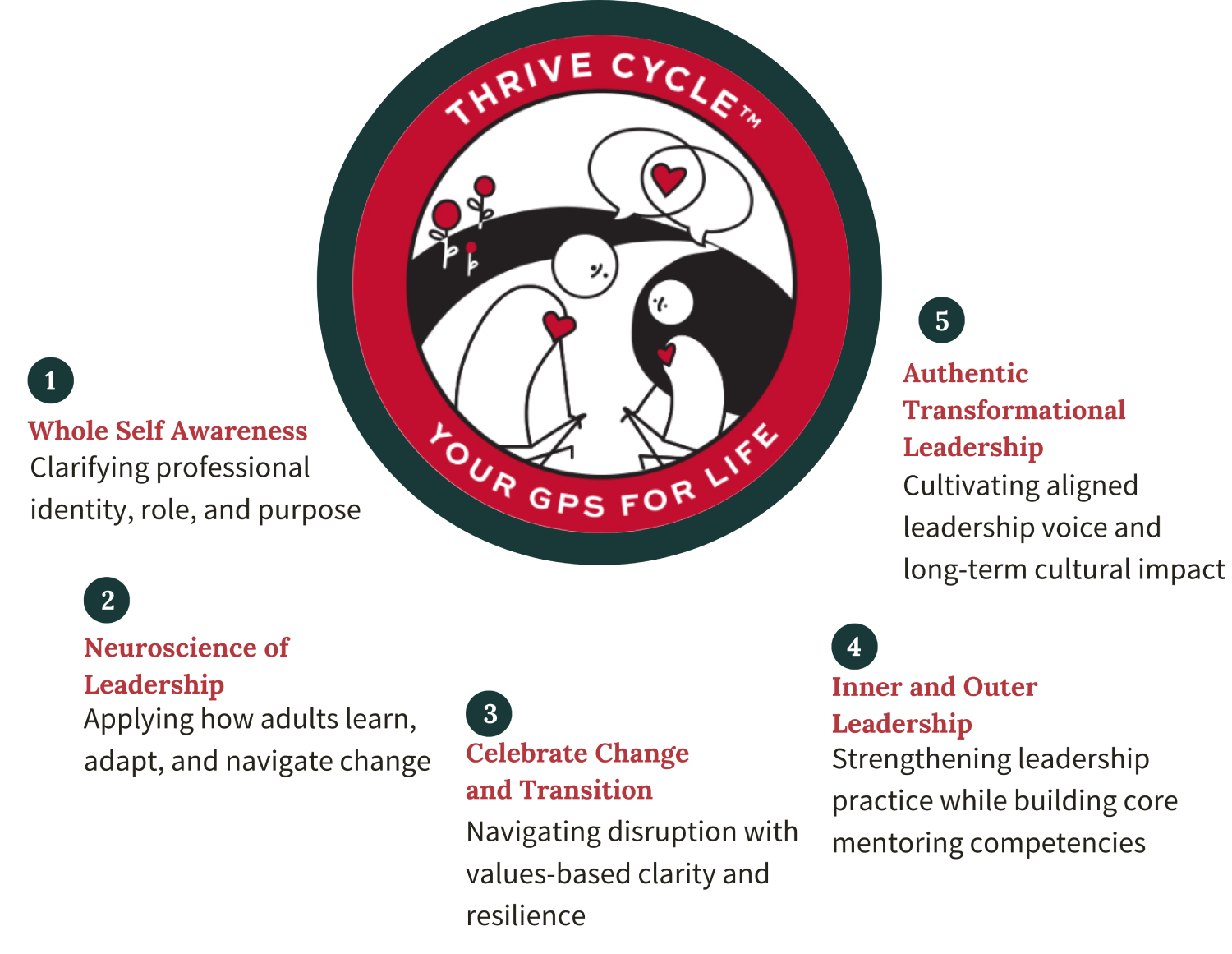
The Thrive Cycle™
A Framework for Building Sustainable Mentoring Infrastructure
The Thrive Cycle™ is a research-informed, five-dimension framework that guides institutions in integrating mentoring into professional development, leadership formation, and organizational systems.
Institutional Integration
The five dimensions work together to create this cohesive structure, strengthening mentoring across roles and career stages.
The Thrive Cycle™ provides the structure that enables mentoring to become part of how an organization learns, leads, and develops its people.
About Christine
I am an educator, author, and mentoring infrastructure strategist.
Over the past five years, I have partnered with nursing education leaders navigating faculty shortages, post-pandemic burnout, and the pressure to do more with less.
I have seen firsthand how deeply leaders care about their faculty and students, and how difficult it is to sustain mentoring without the right structure.
My work centers on a single premise: when mentoring is built as infrastructure, institutions strengthen over time.
I am the author of The Power of Natural Mentoring: Shaping the Future for Women and Girls and the creator of Power2Thrive® and Leading Transformational Mentoring™.
Build the mentoring culture your faculty and students deserve.
Partnering to Build Mentoring Infrastructure
Each engagement is shaped in partnership
Leading Transformational Mentoring™
Cohort-Based Design Partnership
Leading Transformational Mentoring™ is the primary design partnership through which institutions apply the Thrive Cycle™ to build mentoring as sustainable infrastructure.
Unlike traditional mentoring programs that focus primarily on mentor training or matching processes, this work focuses on designing the institutional conditions that allow mentoring to strengthen and sustain over time, across roles and career stages.
It is a structured, 12-week institutional experience in which teams apply the Thrive Cycle™ to their context and co-create a mentoring design ready for institutional pilot implementation—aligned with their culture, capacity, and long-term goals.
Advisory Partnership
Strategic guidance to align mentoring with professional development, leadership formation, and institutional systems.
Speaking Engagements
Keynotes and workshops introducing mentoring as leadership and culture.
Cohort-Based Design Partnership
A structured, 12-week institutional experience where teams apply the Thrive Cycle™ to their context and co-create a mentoring design ready for institutional pilot implementation.
Explore the Thrive Cycle™ Leadership Guide
The Thrive Cycle™ is the framework that grounds every LTM engagement.
If you’d like to explore this work more deeply before stepping into a full design partnership, this guide offers a clear starting point.
Inside, you’ll find:
- The five dimensions of the Thrive Cycle™
- How mentoring shifts from initiative to infrastructure
- Questions institutions can use to assess mentoring readiness
Download the guide to explore how mentoring can be designed to strengthen over time.
We respect your time and your inbox.
Begin the Design Partnership
Begin with a Conversation
Start with a thoughtful 30-minute conversation to explore your context, goals, and questions.
Clarify What Matters Most
Together, we’ll identify what would be most helpful now and what pacing makes sense for your institution.
Design in Partnership
Co-create an approach aligned with your culture, capacity, and long-term goals.